

Understanding the SENSE Framework©
A trauma-focused approach
Gain confidence in your therapy journey.
This page offers a clear overview of the SENSE Framework©, a trauma-focused approach, explaining how our sessions are structured to support your healing and growth.
Click on the diagram to enlarge.
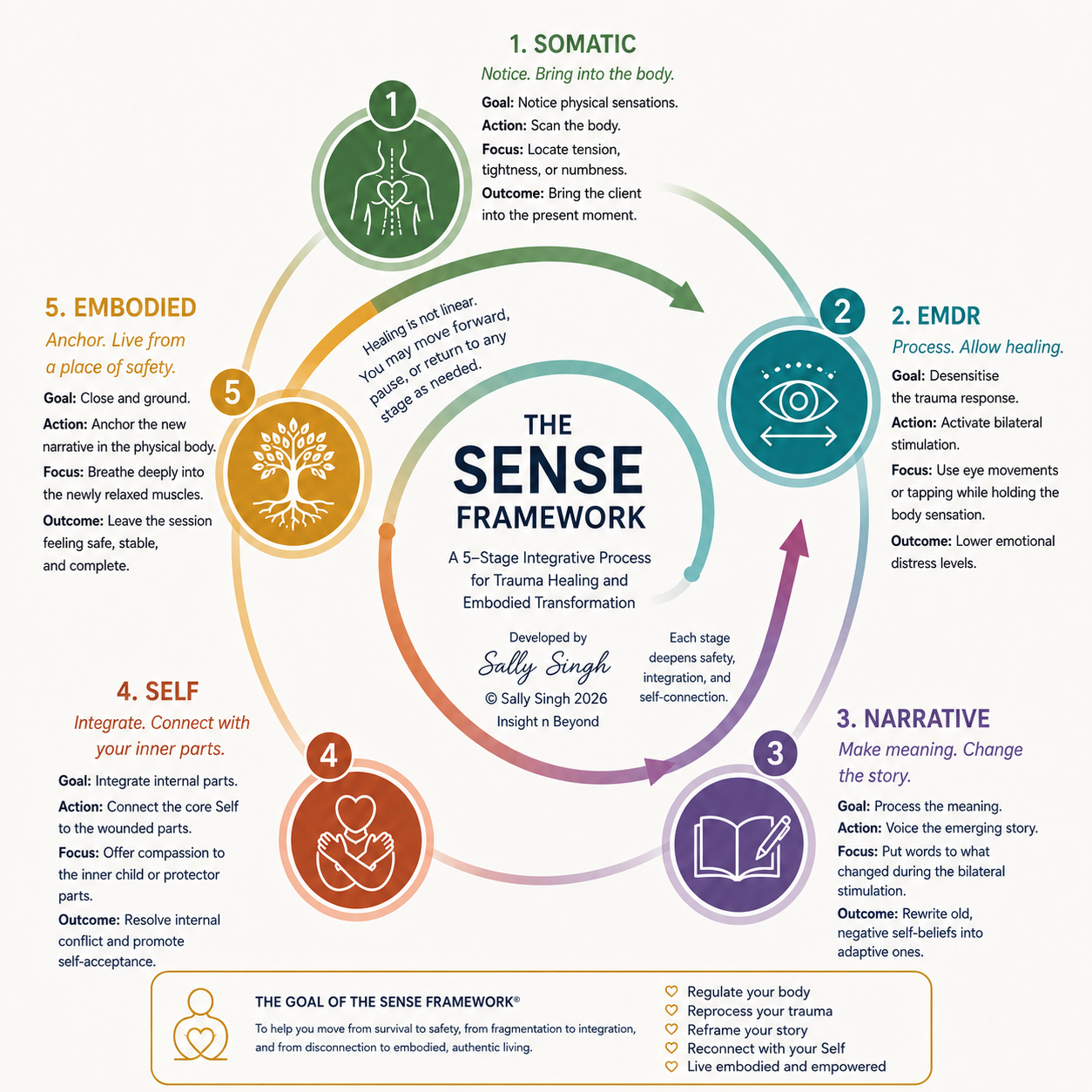

What is the SENSE Framework©?
The SENSE Framework© is an evidence-informed integrative model that synthesises established theories and therapeutic approaches into a sequential framework for trauma recovery. While the individual components of the framework are supported by empirical literature, the integration, sequencing, and clinical decision-making process represent the original contribution of the SENSE Framework©.
The SENSE Framework© is an integrative clinical framework for trauma developed by Sally Singh, over the years, whilst working with complex presentations which needed creative approaches. The SENSE Framework© takes from the conceptual foundations found in established clinical models of trauma therapy and intergrades them in to a workable model.
It facilitates the resolution of unresolved trauma through the sequential integration of somatic awareness, adaptive information processing, narrative reconstruction, Self-led internal integration, and embodied regulation.
This framework was developed in response to a recurring clinical observation: while many trauma therapies effectively address isolated components of trauma, clients often require a structured process that intentionally integrates the body, brain, nervous system, internal attachment systems, personal meaning-making, and lived experience.
Rather than viewing trauma as solely a psychological disorder, the SENSE Framework© conceptualises trauma as a disruption of neurobiological regulation, autobiographical coherence, relational safety, and embodied identity. The framework therefore provides a structured pathway that supports movement from survival-based functioning toward integrated neurobiological regulation, coherent identity, relational safety, and meaningful engagement with life and wellbeing.
The SENSE Framework© is founded on the belief that trauma recovery involves more than symptom reduction. Sustainable healing requires integration across the body, brain, nervous system, identity, and relationships.
The framework supports clients in moving through five interconnected therapeutic phases:
Somatic Awareness → Trauma Processing → Narrative Reconstruction → Self Integration (Identity Building) → Embodied Healing
This progression reflects the understanding that lasting transformation occurs when individuals are able to notice their internal experience, process unresolved memories, reconstruct meaning, develop compassionate self-leadership, and embody a felt sense of safety.
The ultimate aim of the SENSE Framework© is not simply to help individuals remember differently—it is to help them live differently, with greater regulation, resilience, authenticity, and freedom.
Therapeutic foundations the SENSE Framework© is built on?
THE SENSE FRAMEWORK© Acronym Breakdown:
- S – Somatic: Cultivating body awareness and tracking physical sensations to regulate stress and activation levels.
- E – EMDR: Eye Movement Desensitization and Reprocessing, a technique for addressing trauma.
- N – Narrative: Engaging in storytelling and meaning-making around past events. Developing an agentic identity over the course of the therapy.
- S – Self / System: Utilizing parts work to engage with internal protective and wounded aspects.
- E – Embodied: Integrating mind, body, and narrative to promote healing within the nervous system, bring about mindful awareness of possibilities.
1. Somatic Awareness from Somatic Therapy
The objective is to become aware of physical sensations. We conduct a body scan to identify tension, tightness, or numbness, helping you stay present.
2. EMDR (Eye Movement Desensitization and Reprocessing)
The goal is to desensitize the trauma response. This includes activating bilateral stimulation through eye movements or tapping while focusing on bodily sensations, thereby reducing emotional distress.
3. Narrative Reconstruction from Narrative Therapy
We explore meaning together by articulating the emerging story. The emphasis is on expressing changes experienced during bilateral stimulation, transforming old, negative self-beliefs into healthier ones, allowing a more agentic identity to evolve.
4. Self-Led Internal Integration from IFS and Ego-State Therapies
The aim is to integrate internal parts by connecting your core Self with wounded aspects. We foster compassion for your inner child or protective parts, resolving internal conflicts and encouraging self-acceptance.
5. Embodied Regulation from Mindfulness
To conclude and ground the session, we anchor the new narrative within the physical body. You'll breathe deeply into relaxed muscles, leaving the session with a sense of safety and security.

Confidence in your healing journey
My primary aim with the SENSE Framework© is to clearly show you how we will work in our sessions. This transparency ensures you feel confident and fully understand the therapeutic process you are receiving at Insight n Beyond.
Definition of Healing
Within the SENSE Framework©, healing is defined as:
The restoration of embodied safety, adaptive memory integration, coherent identity, compassionate Self-leadership, and relational agency, enabling individuals to respond to present experiences from regulation rather than survival.
Healing is not the absence of painful memories. Healing is the capacity to remember without reliving, to connect without abandoning oneself, and to move through life with flexibility, resilience, and choice.
"Healing begins when the body feels safe, the mind makes meaning, the Self leads with compassion, and the nervous system learns that the danger has passed." Sally Singh, Developer of the SENSE Framework©

"Healing within the SENSE Framework© is the restoration of embodied safety, adaptive memory integration, coherent identity, compassionate Self-leadership, and relational agency, enabling individuals to respond to present experiences from regulation rather than survival".
Sally Singh, Developer of the SENSE Framework©, 2026