

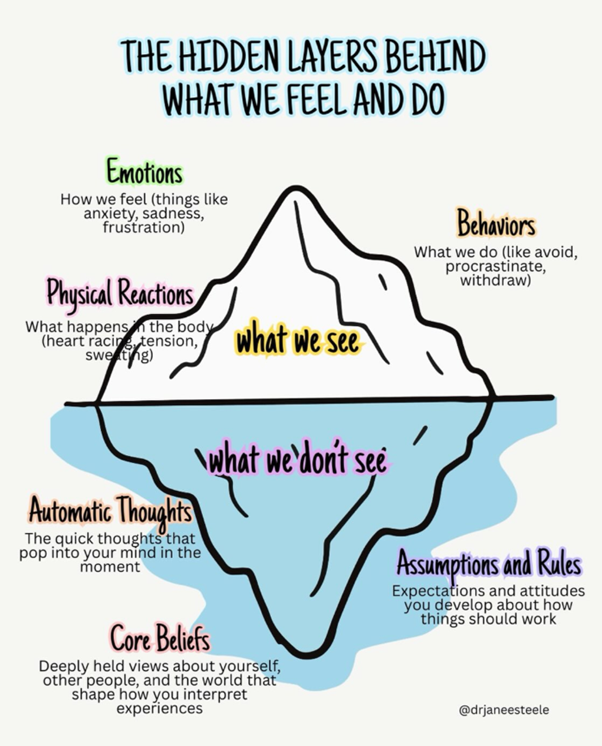
The Iceberg of the Mind
Understanding what drives your sudden emotional reactions is the first step toward finding peace.
Have you ever had a moment where you completely overreacted to something small, only to wonder later, "Why did I get so upset?" Maybe a partner forgot to buy milk, and it turned into a massive argument. Or perhaps a friend didn't reply to a text, and you spent the night convinced they secretly hate you.
To help make sense of these confusing moments, renowned psychologist Dr Daniel Fox developed a simple but powerful idea: "Core Content" versus "Surface Content". This concept explains that our emotional lives operate on two entirely different levels. What we show to the world on the outside is usually just a shield protecting a deeply hidden wound on the inside.
To understand how this works, picture an iceberg floating in the ocean or see diagram above.
1. Surface Content (Above the Water)
Surface content consists of the behaviors, moods, and immediate reactions that everyone can see. This is how your mind handles stress in the moment.
- Sudden outbursts of anger or slamming doors.
- Giving someone the "silent treatment" or shutting down.
- Overeating, stress-shopping, or doom-scrolling to distract yourself.
- Anxious overthinking and constant people-pleasing.
2. Core Content (Below the Water)
Core content represents your deepest fears, old memories, and hidden beliefs about yourself. These are often shaped by tough experiences early in life and remain buried out of sight.
- A deep fear of being abandoned or left behind.
- Extreme sensitivity to rejection or feeling left out.
- A quiet, lingering belief that you aren't "good enough."
- A feeling of emptiness, as if something vital is missing.
How the Two Connect: The Ripple Effect
Surface behaviors don't just happen out of nowhere—surface content is always triggered by an old fear hiding in your core content.
Imagine a coworker critiques a report you wrote. That is the trigger. On the surface, you might snap at them or decide you want to quit your job. But underneath the water, that critique hit your core content: an old, painful belief that you are a failure. Because looking directly at that core belief hurts too much, your brain instantly throws up a surface shield—like anger or avoidance—to protect you.
Healing the Base of the Iceberg: Enter EMDR
Traditional "talk therapy" is fantastic for managing surface content—it gives you great tools to calm down when you are already upset. But to truly stop the surface cycles, you have to heal the core wounds below the water. This is where Eye Movement Desensitization and Reprocessing (EMDR) comes in.
EMDR is a specialized therapy designed to help the brain reprocess traumatic or highly distressing memories. Always seek a qualified profession for this work.
When you experience something painful in the past, your brain sometimes files that memory away incorrectly, leaving it "emotionally raw." Years later, a minor trigger wakes that old memory up, activating your core content.
EMDR helps melt away that heavy core content in three distinct ways:
- Unlocking the Root Memory: EMDR bypasses the surface shields and targets the specific, old experiences that created your core beliefs (like the childhood moment you felt abandoned or rejected).
- Rewiring the Brain's Response: By using bilateral stimulation (such as guided eye movements or rhythmic taps) while recalling the memory, EMDR helps your brain file the memory away properly as "history," taking away its emotional sting.
- Shifting the Core Belief: As the memory loses its pain, your core content naturally transforms. The old whisper of "I am not safe" or "I am worthless" is replaced by a deep, felt belief of "I am safe now" or "I am completely enough."
How to Practice Change Every Day
- Catch the Surface: The next time you feel a massive spike of anxiety, anger, or the urge to run away, pause and label it: "This is my surface reaction."
- Find the Core: Ask yourself honestly: "What old story did this situation wake up? Am I feeling rejected, unloved, or helpless?"
- Choose the Positive Route: Remind yourself that the current situation is just a minor trigger, not the old memory. Choose one small, positive adaptation—like a deep breath or a vulnerable statement—to handle it differently.
By separating what is happening on the surface from what is hurting at the core—and using therapy like EMDR to heal those deeper wounds—you stop letting old fears run your life. You can't always stop the ocean waves from tossing you around, but understanding your iceberg gives you the power to steer through the storm. At Insight n Beyond this iceberg is well understood, come learn about your iceberg now.