

How the Brain Processes Trauma and Supports Healing : Understanding the Adaptive Information Processing (AIP) Model
Why do some experiences stay with us long after they have happened, while others become memories that we can recall without feeling overwhelmed?
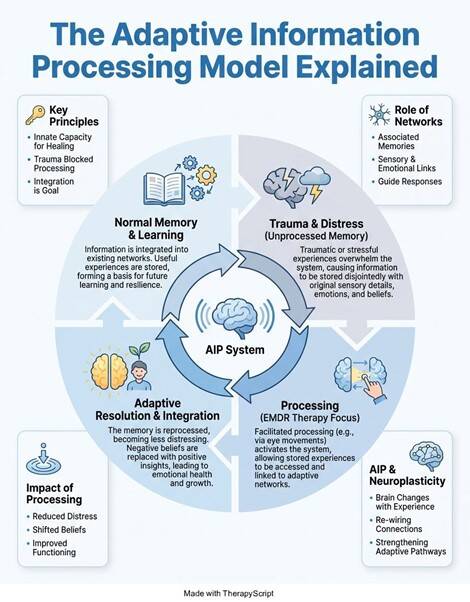
To understand trauma and how healing occurs, it is helpful to explore the Adaptive Information Processing (AIP) Model. This model provides an important framework for understanding how the brain processes experiences, how traumatic memories can become stuck, and how therapeutic approaches such as Eye Movement Desensitisation and Reprocessing (EMDR) can support the integration of unresolved experiences.
At the heart of the AIP Model is a fundamental assumption: we have an innate capacity to process experiences and move towards psychological healing. However, when an experience is overwhelming, this natural processing can become disrupted.
What is the Adaptive Information Processing Model?
The Adaptive Information Processing Model, developed by Dr Francine Shapiro, the American psychologist who founded Eye Movement Desensitisation and Reprocessing (EMDR) therapy, proposes that the brain has a natural information-processing system that works to integrate experiences into existing memory networks.
In everyday life, we encounter experiences, make sense of them, learn from them and store them as memories. These memories become connected to other information, including our emotions, beliefs, physical sensations and previous experiences.
When information is processed adaptively, it becomes integrated into our broader memory networks. We can remember what happened, recognise what we learned and use that information to inform future experiences without necessarily reliving the original emotions.
For example, we might remember an embarrassing experience from childhood. Although we may not particularly enjoy recalling it, we can recognise that it happened in the past. We can reflect on it without experiencing the same intensity of shame, fear or distress.
This is an example of adaptive memory integration.
However, not all experiences are processed in this way.
What happens when trauma disrupts information processing?
When someone experiences something traumatic or highly distressing, the experience may overwhelm their capacity to process and integrate the information at the time.
Rather than becoming fully integrated into existing memory networks, aspects of the experience can remain stored in a more fragmented or unprocessed form.
These memories may retain elements of the original experience, including:
-
Visual images and sounds.
-
Physical sensations and bodily responses.
-
Intense emotions such as fear, shame, helplessness or anger.
-
Negative beliefs about ourselves, others or the world.
-
Sensory and emotional associations connected to the original event.
This helps explain why trauma responses can feel as though the past is happening in the present.
A person may intellectually understand that they are now safe, yet their body and emotional responses may react as though the original threat is still occurring.
For example, someone who experienced an unpredictable or frightening childhood environment may become highly alert to changes in another person's mood. A particular tone of voice, facial expression or disagreement may activate an emotional response that feels disproportionate to what is happening in the present.
The response may not simply be about the current situation. It may also be connected to an earlier experience that has not been fully processed and integrated.
Trauma is not simply about what happened to us; it is also about how the experience was stored and how it continues to influence our present-day responses.
Memory networks: Why the past can influence the present
An important part of the AIP Model is the concept of memory networks.
Our memories are not stored as isolated events. They are associated with other memories, emotions, physical sensations, beliefs and experiences.
For example, an experience of rejection may become connected to beliefs such as:
-
I am not good enough.
-
I am unlovable.
-
People will eventually leave me.
-
I cannot trust others.
When a similar experience occurs later in life, it may activate this existing memory network.
This can help explain why seemingly small situations sometimes trigger intense emotional responses. The current event may be activating a much larger network of associated experiences.
It is also why two people can experience similar situations but respond very differently. Their responses are influenced not only by the current event but also by their individual histories, existing memory networks and previous experiences.
Understanding these connections can help move therapeutic work beyond simply addressing the presenting behaviour or emotional response and towards understanding what may be driving it.
How does EMDR support adaptive information processing?
EMDR therapy is based on the Adaptive Information Processing Model.
The approach works with the understanding that unresolved traumatic memories can remain inadequately integrated within the person's memory networks. EMDR aims to facilitate the processing of these experiences so that they can become more adaptively integrated.
During EMDR, the therapist supports the client in accessing aspects of a distressing memory while introducing bilateral stimulation, commonly through eye movements, tapping or alternating auditory stimulation.
This process is intended to facilitate information processing, allowing aspects of the previously distressing experience to be accessed and connected with more adaptive information.
As processing progresses, the memory may become less emotionally distressing. The person may develop a different understanding of the experience, and previously held negative beliefs may begin to shift.
For example, a memory previously associated with the belief "I am powerless" may become associated with a more adaptive understanding, such as "I survived, I have choices now, and I am no longer in that situation."
Importantly, the aim is not to erase the memory or pretend that the experience did not happen.
The aim is to change how the memory is experienced and how it influences the person's present-day emotional and psychological functioning.
Adaptive resolution and integration: What does healing look like?
Within the AIP framework, healing involves the reprocessing and integration of previously distressing memories.
As memories become more adaptively integrated, several changes may occur:
-
Reduced emotional distress: Remembering an experience no longer produces the same intensity of emotional or physiological activation.
-
Shifted beliefs: Negative beliefs associated with the experience may be replaced by more balanced and adaptive perspectives.
-
Greater emotional regulation: The person may find it easier to respond to present-day situations without being overwhelmed by past experiences.
-
Improved functioning: Relationships, decision-making, confidence and everyday activities may become less affected by unresolved trauma.
-
Increased psychological resilience: The person can draw on new insights and experiences to support future learning and growth.
The experience itself does not change. What changes is the way the person relates to it, remembers it and carries it into their present life.
AIP and neuroplasticity: The brain's capacity for change
The AIP Model also connects with our understanding of neuroplasticity: the brain's capacity to change and reorganise through experience.
As new information is processed and integrated, neural connections and pathways can change. This provides a biological context for understanding how therapeutic experiences can contribute to changes in emotional responses, beliefs and patterns of functioning.
Rather than remaining defined by the emotional and psychological impact of previous experiences, individuals can develop new associations and strengthen more adaptive ways of responding.
This is an important part of understanding trauma recovery. Healing is not simply about learning to manage symptoms or developing strategies to cope with distress. It can also involve changing the underlying associations that contribute to those responses.
What does this mean for trauma-focused therapy?
The AIP Model offers an important shift in how we understand psychological distress.
Instead of viewing symptoms as isolated problems that need to be eliminated, it encourages therapists to consider whether current difficulties may be connected to earlier experiences that have not been fully processed.
Anxiety, emotional reactivity, negative self-beliefs, relationship difficulties and patterns of avoidance may sometimes be connected to unresolved memories and the networks associated with them.
This does not mean that every psychological difficulty originates in trauma, or that every presenting issue requires memory reprocessing. Rather, the model provides a framework for exploring the relationship between past experiences and present-day functioning.
For therapists, this highlights the importance of understanding the person within the context of their history, relationships, environment and individual experiences.
It also reinforces the importance of appropriate preparation, therapeutic safety, pacing and individualised treatment.
Healing is about integration, not forgetting
One of the most valuable aspects of the Adaptive Information Processing Model is its emphasis on the brain's capacity for healing.
Traumatic experiences can have a lasting impact, but they do not have to remain the organising force behind how we experience ourselves, our relationships and the world.
We cannot change what happened to us. However, through appropriate therapeutic support, we can work towards changing how those experiences are stored, understood and experienced in the present.
The goal is not to erase the past, but to help the past become the past.
Healing is about reaching a place where we can live with the impact of our experiences without allowing them to continue to control our lives. It may mean learning to live with manageable pain rather than being overwhelmed by it, remembering difficult experiences without flashbacks or being pulled back into the past, and recognising that what happened no longer determines how we see ourselves or respond to the world.
Healing is about regaining agency, freedom and choice – being able to make decisions without fear, establish boundaries without guilt, develop relationships without constantly anticipating harm, and respond to the present rather than being governed by the past. It is the ability to experience life with greater safety, flexibility and self-determination. Ultimately, healing is not about erasing the past, but having a life in which the past no longer has the power to dictate how we live.
When memories are adaptively processed and integrated, we can begin to respond to life from our present circumstances rather than continually responding through the lens of our unresolved experiences. Healing is not about denying what happened or simply learning to live with distress. It is about supporting the natural capacity for information processing, integration and psychological growth.